


Where the classes come from
HEPA classes are defined by the European standard EN 1822. Unlike ASHRAE 52.2, which reports efficiency across three particle size ranges, EN 1822 tests each filter at its most penetrating particle size, the size that slips through that media most easily.
Because the test targets the filter's weakest point, a HEPA class tells you the minimum efficiency for the hardest particle to catch.
| Class | Minimum efficiency | Braden filters |
|---|---|---|
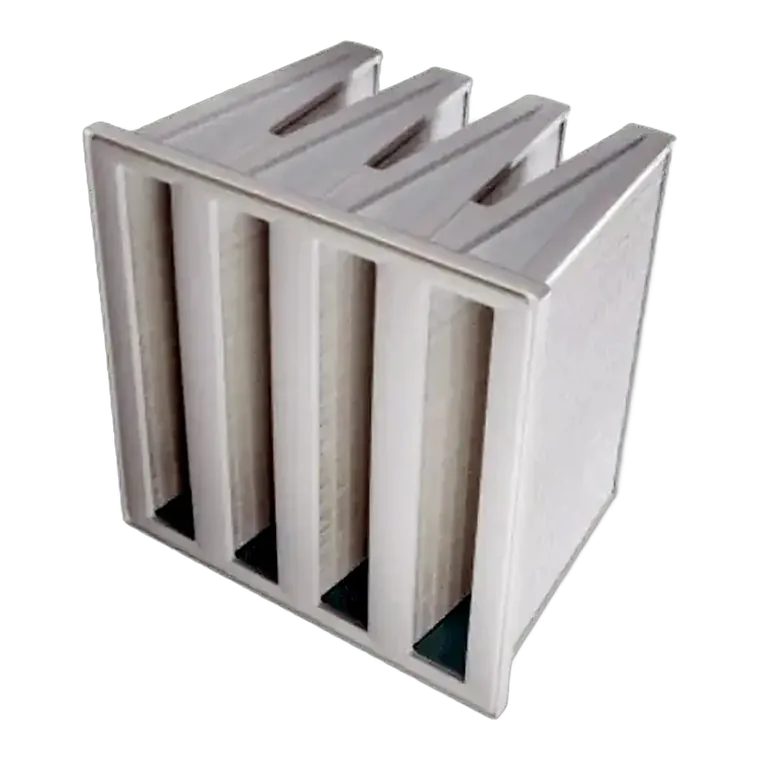
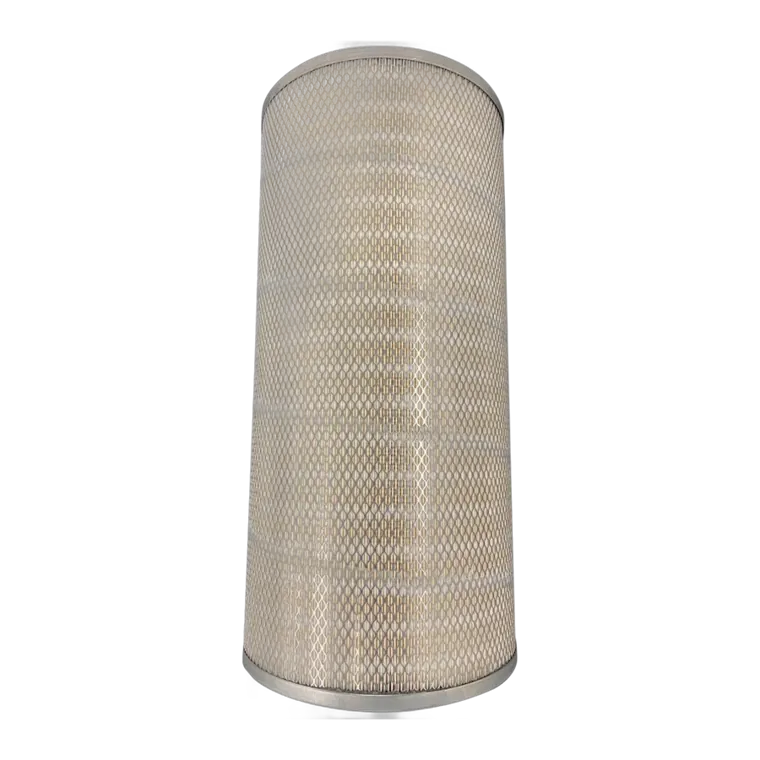
| HEPA E12 | 99.5% | 4V synthetic V-banks, static gas turbine cartridges |
| HEPA H13 | 99.95% | Static gas turbine cartridges |
E12 and H13 side by side
An E12 filter captures at least 99.5 percent of particles at the most penetrating particle size. An H13 filter captures at least 99.95 percent. Put another way, an H13 filter lets through one tenth as many of those particles as an E12.
Both sit above MERV 16 on the efficiency scale used on this site. Braden manufactures up to HEPA H13.
Where Braden builds HEPA
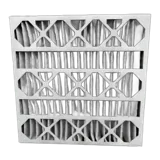
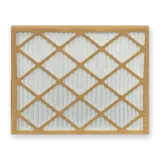
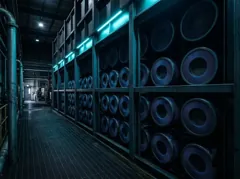
Braden manufactures 4V synthetic V-banks in HEPA E12 for high-airflow systems such as data halls and gas turbine inlets.
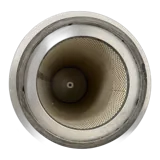
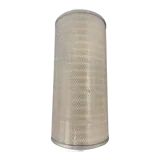
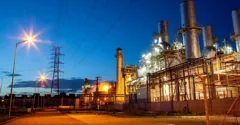
For gas turbine inlets, Braden manufactures static cartridges in HEPA E12 and H13, as cylinder and conical sets. Static cartridges are not pulse-cleaned and are replaced when loaded.
Standards references: ASHRAE Standard 52.2 (MERV), EN 1822 (HEPA). Braden product ratings from Braden Filtration.